An Ottoman Turkish document viewer built with Claude Cowork
Updated UI/UX and functionality

This article | The viewer | Functionality | The machine transcription | Updated UI/UX and functionality | Contact me if you would like to learn more
This article
I’m sharing the product of five hours work with Claude Cowork spread over a day. I have been using Cowork now for ten days and this is my biggest project to date. I’m an historian, not a coder. Cowork has been a revelation.
The product is a static five annotation layer IIIF viewer for Ottoman Turkish, which I am hosting in a IIIF-demo repository on the ai and history collaboratory GitHub organisation. The image the viewer displays is from the first issue of the Ottoman government gazette Takvîm-i Vekâyi, published in 1831.
The viewer
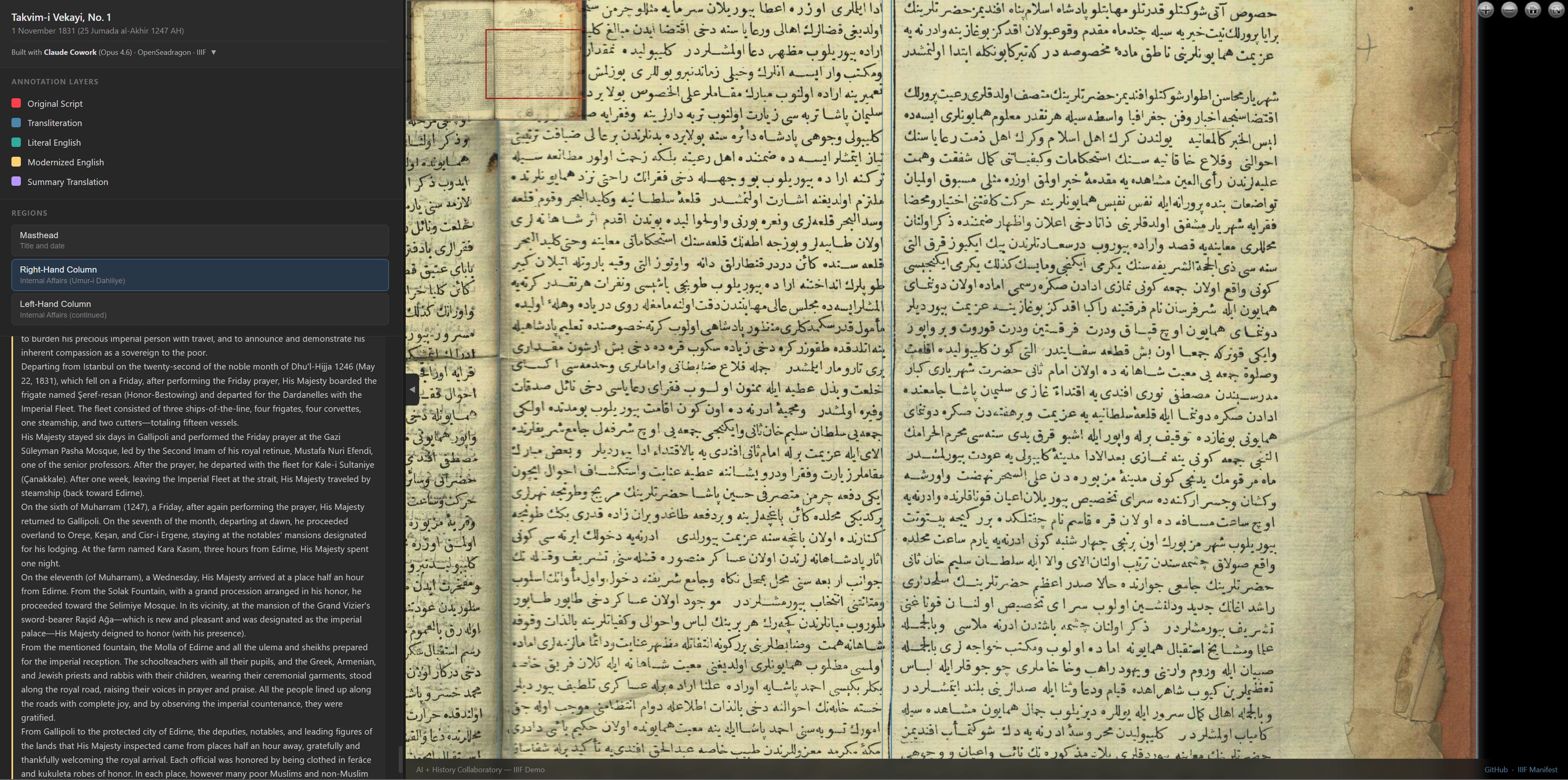
You can access the viewer here and the related documentation here.
Functionality
The viewer provides a zoomable tiled image in the main area of the screen and a vertical side bar from which to access five annotation layers.
Digital transcription of the original perso-arabic script
Ottoman Turkish transliteration
Literal English
Modernised English
Summary translation
The vertical sidebar provides access to the annotation layers, which can be toggled on and off, and offers the choice of three regions within the image to inspect - the masthead, and the right and left hand columns.
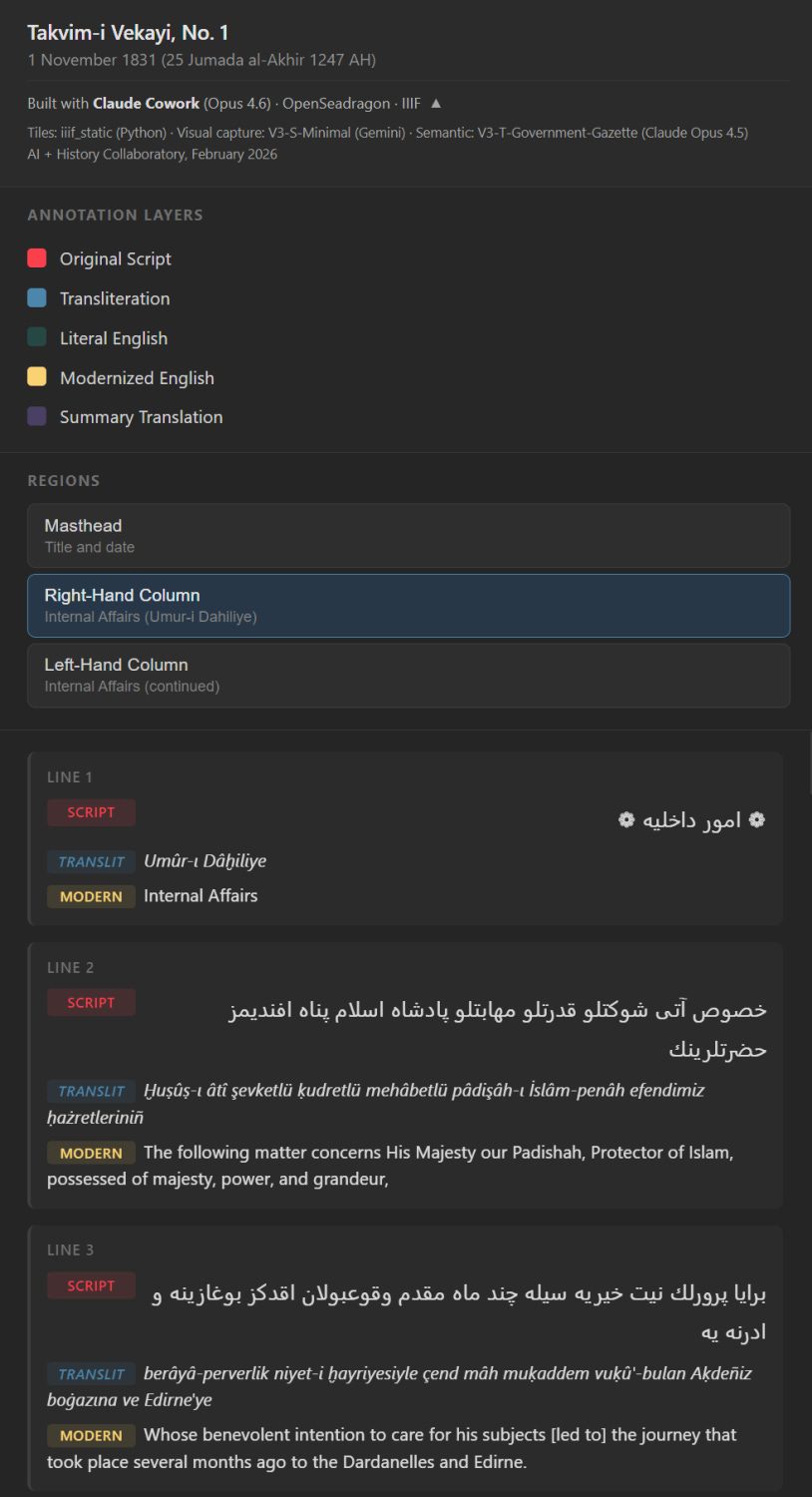
The machine transcription
The machine transcription was done using a two stage process - visual capture using Gemini 3 Pro to produce a digital transcription of the original perso-arabic script and semantic processing of that digital transcription using Opus 4.5 to produce an Ottoman Turkish transliteration, a literal Englsh translation and a modern English translation, together with a flowing summary translation.
It’s not perfect, but it’s a start. Your feedback on the quality of the HTR and on our approach to machine transcription of Ottoman Turkish documents would be enormously valuable. Everything we are doing is for the Commons, and will benefit Ottoman Turkish scholarship, and ultimately scholarship in other important languages of the Ottoman Empire and its successor states, including Albanian, Bulgarian, Greek and Armenian.
This two-stage pipeline is documented in the Opening the Ottoman Archive initative wiki, which provides a project introduction and describes the visual capture and semantic processing stages we are developing. The initiative is still at its early stages, and follows on from an early January 2026 article I wrote in my substack Generative Lives.
I am working with a number of Ottoman Turkish scholars in Europe and the US to develop specialised HTR skills files tailored for the visual capture and semantic processing of different scripts, genres and document types across a range of periods. Until now we have concentrated on the C19th and early C20th and have worked with printed and lithographed documents - gazettes, newspapers and books. But we are now devoting our attention to handwritten texts, which of course present a bigger HTR challenge, and are reaching out to scholars with expertise in C16th to C18th texts in a range of scripts.
Updated UI/UX and functionality
Two hours of Cowork interaction this Sunday morning and two more hours Sunday afternooon working on UI/UX.
New features:
Five pages of HTR
Accordion sidebar boxes
Persistent region indicator bar
Persistent page indicator bar
Red highlights for clickable regions with instant display of chosen level of annotations.
Thumbnails of double page images at base of viewer
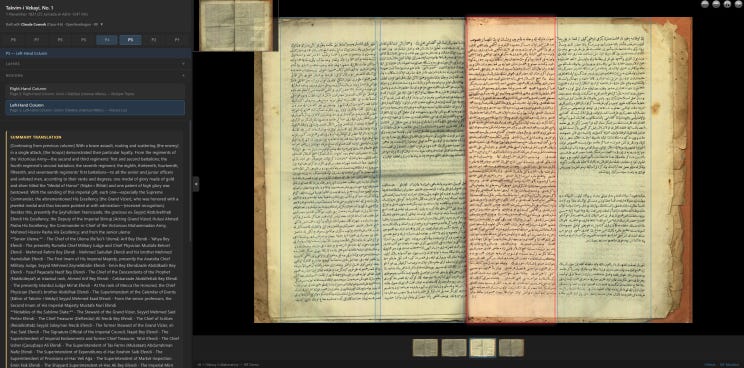
Takvim-i Vekayi, issue 1, 1831: Improved UI/UX

New Right to Left thumbnail navigation,
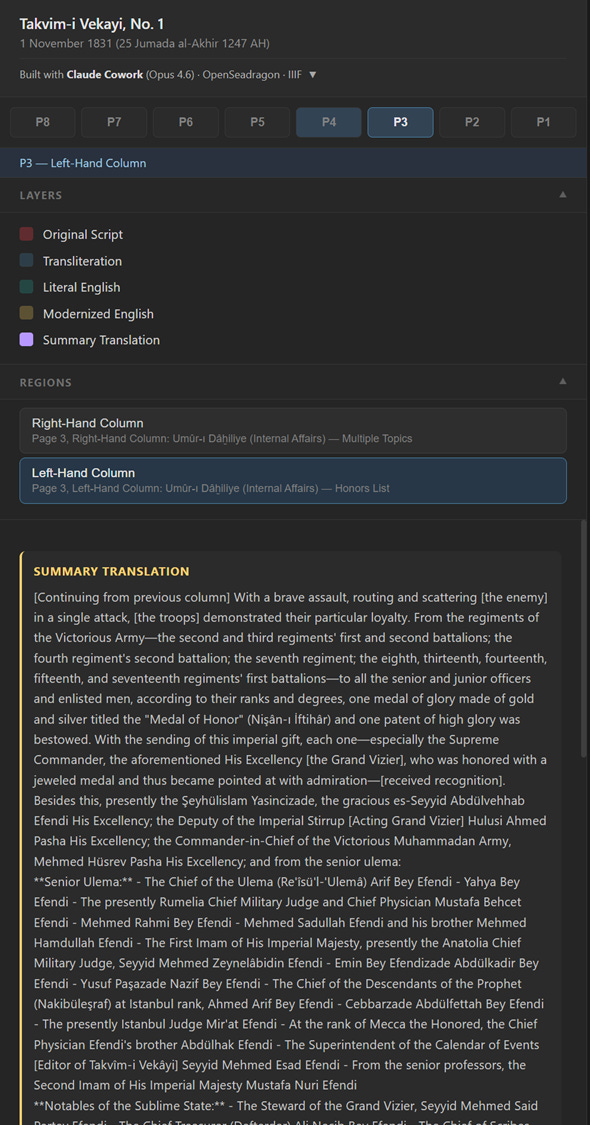
Takvim-i Vekayi, issue 1, 1831: Improved UI/UX of lefthand sidebar
Same viewer link. Please give it a try and post feedback in comments.
Contact me if you would like to learn more
Please connect with me on LinkedIn and message me if you would like to learn more about our initiative and to contribute to the co-creation, testing and validation of Ottoman Turkish HTR skill files in the context of your own research projects.
Very cool, Colin! Seems extremely useful, potentially.
I have updated the UI/UX for the Ottoman Turkish viewer. New features: Two pages of HTR; Accordion sidebar boxes; Persistent region indicator bar; Red highlights for clickable regions with instant display of chosen level of annotations. Here is the link to the viewer: https://ai-and-history-collaboratory.github.io/iiif-demo/viewer.html